
What Is UltraHumanizer.ai?
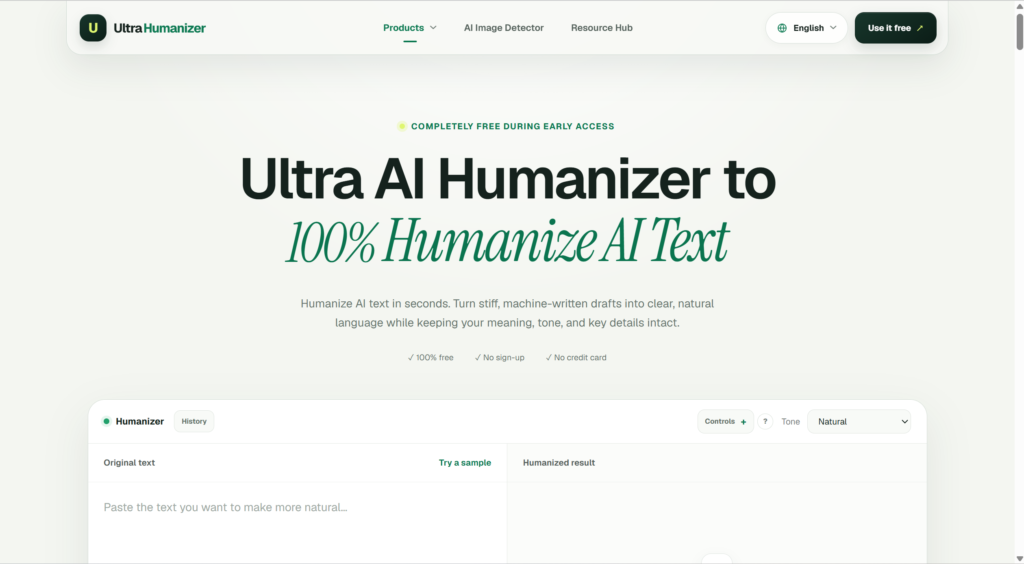
AI tools can create text and images faster than ever, but that has created a new set of problems.
AI-written drafts often still need editing before they’re ready to publish. They can sound repetitive, overly formal, or unnecessarily verbose. At the same time, the growth of AI-generated imagery has made it increasingly difficult to judge whether a photo, illustration, or screenshot was created or substantially modified using generative AI.
UltraHumanizer approaches both problems from one platform.
Its primary product is a free AI humanizer designed to turn stiff AI-assisted drafts into clearer, more natural writing while preserving the original meaning, tone, and important details. The platform has also introduced a free AI Image Detector, giving users a separate tool for analyzing visual content for signals associated with generative AI.
At the time of this review, both tools can be accessed for free, making UltraHumanizer particularly interesting for writers, marketers, content teams, businesses, and anyone working regularly with AI-generated content.
UltraHumanizer.ai Review: Quick Verdict
Overall Rating: 4.8/5
UltraHumanizer.ai has grown beyond a basic text rewriter.
The AI Humanizer remains the strongest part of the platform. It supports drafts of up to 12,000 words, lets users upload common document formats, offers multiple writing tones, and keeps the rewritten output editable. The tool is currently completely free during early access and doesn’t require an account or credit card.
The addition of the AI Image Detector makes the platform more interesting.
Instead of only helping users improve AI-assisted writing, UltraHumanizer can now also analyze JPG, PNG, and WebP images up to 10 MB and return an estimated AI likelihood score with additional context. Importantly, UltraHumanizer describes the result as a likelihood assessment rather than definitive proof of how an image was created.
That distinction matters. AI detection—whether for text or images—is probabilistic, so treating the result as supporting evidence rather than an absolute verdict is the more responsible approach.
How Does the UltraHumanizer AI Humanizer Work?
Using UltraHumanizer is straightforward.
You start by pasting an existing draft into the editor or uploading a document. The platform currently accepts DOCX, PDF, PPTX, ODT, RTF, TXT, Markdown, and LaTeX files, with file uploads up to 20 MB. The text editor itself supports as many as 12,000 words.
This relatively high word limit makes a noticeable difference.
Many simple rewriting tools work fine when you’re editing a few sentences but become frustrating when you’re trying to process a 3,000-word blog post or a detailed business report. UltraHumanizer’s current limit makes it much more suitable for long-form workflows.
Once your text is loaded, you can choose how you want it rewritten.
Three Writing Tones
UltraHumanizer currently provides three primary tone options: Natural, Conversational, and Professional.
Natural is the most balanced option. It’s useful when the original draft is basically correct but needs smoother phrasing and more varied sentence structure.
Conversational is better for blog posts, newsletters, marketing copy, social content, and other situations where a formal AI-generated voice can feel out of place.
Professional is designed for reports, proposals, emails, project updates, and workplace communication where you want the content to remain polished without sounding unnecessarily complicated.
The important point is that UltraHumanizer isn’t simply replacing words with synonyms. Its stated approach includes varying sentence rhythm, removing predictable filler, improving transitions, and maintaining the meaning of the original text.
Editable Results Make the Workflow More Practical
One feature I particularly like is that UltraHumanizer doesn’t treat the generated rewrite as something you have to accept unchanged.
The result remains editable.
You can compare it with the original version, check important details, change individual sentences, and continue refining the text before copying the final version.
That’s closer to how AI-assisted editing should actually work.
A useful workflow isn’t:
AI → Publish
It’s closer to:
AI draft → UltraHumanizer → Review → Manual edits → Publish
Automation handles repetitive cleanup, while the person using the tool keeps control of the final result.
Meaning and Keyword Preservation
One of the risks of using any rewriting tool is semantic drift.
You may start with a factually correct sentence and receive something that sounds better but subtly changes what you meant.
UltraHumanizer specifically says its humanizer is designed to preserve names, facts, context, intent, and key terms during rewriting. It also includes an SEO-aware approach intended to retain important search terms rather than automatically replacing them with unnecessary alternatives.
This makes the tool particularly relevant for SEO teams.
If you’re optimizing a page around a specific term, product name, or branded phrase, you don’t necessarily want a paraphraser rewriting that phrase every time it appears.
UltraHumanizer still recommends manually checking names, statistics, dates, citations, and other important information before publishing, which is sensible because it is an editing tool rather than a fact-checking system.
UltraHumanizer.ai AI Image Detector
The most notable newer addition to UltraHumanizer.ai is its free AI Image Detector.
The tool is designed to estimate whether an uploaded image contains visual patterns associated with AI generation or substantial AI editing. Users upload an image, run the analysis, and receive an AI likelihood score together with concise context explaining the assessment.
This makes UltraHumanizer useful beyond text editing.
For example, someone reviewing online content may want an additional signal when looking at an unfamiliar product image, social media visual, illustration, or other digital asset.
The process is simple: upload an image, run the analysis, and review the likelihood assessment.
What Does the AI Image Detector Tell You?
UltraHumanizer divides its AI Image Detector results into three broad confidence ranges.
| AI Likelihood | Interpretation |
|---|---|
| 0–44% | Low AI likelihood |
| 45–79% | Mixed or uncertain |
| 80–100% | High AI likelihood |
A low result means the system found relatively few known visual signals associated with AI generation. A middle score indicates mixed evidence, while a high score suggests stronger patterns associated with generated or substantially AI-edited imagery.
However, UltraHumanizer repeatedly makes an important distinction: the score isn’t proof.
A 10% result doesn’t prove that an image came directly from a camera, just as a 90% result doesn’t establish exactly which tool created it.
Instead, the detector is best used as one piece of information alongside the image’s source, metadata, provenance, visible editing, and other available context.
Supported Images
The UltraHumanizer AI Image Detector currently accepts:
JPG, PNG, and WebP files up to 10 MB.
The site recommends using the original image where possible because screenshots, repeated compression, cropping, filters, and other transformations can remove or change visual information that may affect the analysis.
That’s worth keeping in mind if you’re testing an image downloaded from social media.
A heavily compressed screenshot isn’t necessarily going to produce the same result as the original file.
Can an AI Image Detector Be 100% Accurate?
No.
And one thing UltraHumanizer gets right is that it doesn’t present AI image detection as absolute proof.
Generative models are constantly changing. Partial AI editing can also make classification much harder.
For example, a real photograph could contain generative fill in only one small area. A professionally retouched image might contain visual characteristics that resemble synthetic imagery. Digital illustrations and CGI can also sometimes look similar to AI-generated images.
UltraHumanizer itself identifies screenshots and compression, partial AI editing, unfamiliar generation models, stylized artwork, filters, and CGI as factors that can influence results.
So the image detector is most useful as an additional review signal, not as a final judgment.
Privacy and Image Analysis
Privacy is particularly important for image detection tools because users may be tempted to upload private photos or business assets.
UltraHumanizer states that images aren’t written to its own storage or added to a public gallery. The selected image is transferred through the service to the configured AI analysis provider in order to return the requested assessment.
Even with that approach, the platform recommends not uploading confidential client work, identification documents, medical imagery, unreleased creative assets, or other sensitive images without first reviewing the applicable privacy terms.
That’s a sensible rule to follow with any cloud-based AI analysis service.
UltraHumanizer.ai for Content Writers
For writers, the AI Humanizer is still likely to be the main reason to use UltraHumanizer.
AI-generated drafts often have recognizable stylistic problems even when the underlying information is useful.
Sentences can be unnecessarily long.
Paragraphs follow similar structures.
The same transitions appear repeatedly.
Everything sounds polished in exactly the same way.
UltraHumanizer helps automate some of that cleanup while leaving the final output editable.
For a writer using ChatGPT, Claude, Gemini, or another AI system to accelerate first drafts, UltraHumanizer can fit naturally between generation and final editing.
UltraHumanizer.ai for Marketing Teams
Marketing teams may benefit even more because AI-generated marketing language can become generic very quickly.
Phrases such as “unlock your potential,” “revolutionize your workflow,” and “cutting-edge solution” appear so frequently that they often weaken rather than strengthen marketing copy.
UltraHumanizer can help make those drafts more direct.
The Conversational mode works particularly well for blog posts, newsletters, landing-page drafts, and social content, while Professional mode can be used for client-facing or corporate communication.
The AI Image Detector also adds another potentially useful tool for marketing and content operations teams reviewing external visual assets.
UltraHumanizer.ai for Business Writing
One of the most practical applications of AI humanization has little to do with publishing articles.
It’s ordinary business communication.
AI frequently turns a simple message like:
We’ve completed your request.
into something closer to:
We are pleased to inform you that your recent request has now been successfully processed by our team.
The longer version isn’t technically incorrect.
It’s just unnecessarily formal.
UltraHumanizer’s Professional mode can be useful for making emails, reports, proposals, internal updates, and customer communication clearer without making them unprofessional.
For teams that already use AI heavily, saving a few minutes of manual cleanup across dozens of everyday documents can add up.
UltraHumanizer.ai for SEO
UltraHumanizer also fits naturally into an AI-assisted SEO workflow.
A content team might use AI to produce an outline and initial draft, then use UltraHumanizer to reduce repetitive phrasing before an editor performs the final content review.
The ability to retain important search terms is valuable here, because aggressive paraphrasing tools can sometimes replace phrases you deliberately want to keep. UltraHumanizer explicitly positions its humanizer as SEO-aware and says it can retain important search terms while making surrounding sentences feel more natural.
Of course, humanization alone doesn’t make an SEO article competitive.
Useful information, search-intent alignment, original examples, internal linking, accurate sourcing, and editorial quality still matter.
UltraHumanizer addresses the writing layer rather than replacing the whole SEO process.
UltraHumanizer.ai Pros and Cons
Profis
- Completely free during early access
- No sign-up or credit card required
- Up to 12,000 words per text request
- Natural, Conversational, and Professional writing modes
- Supports document uploads
- Editable humanized results
- Designed to preserve meaning and important keywords
- Supports more than 30 languages
- Includes a free AI Image Detector
- AI Image Detector provides likelihood ranges rather than claiming certainty
Nachteile
- Humanized text still needs factual review
- The humanizer isn’t a fact-checking tool
- AI image detection cannot establish image provenance with certainty
- Compressed or heavily edited images may be harder to analyze
- Free access is currently described as an early-access offering and could change later
Is UltraHumanizer.ai Free?
Yes.
UltraHumanizer currently describes its main AI Humanizer as completely free during early access, with no sign-up or credit card required. Users can process documents containing up to 12,000 words.
The AI Image Detector is also currently free to use without requiring an account or payment to start, although the site notes that availability can be subject to fair-use limits.
That gives UltraHumanizer a significant advantage for people who don’t want to subscribe to yet another AI utility before determining whether they actually need it.
Is UltraHumanizer.ai Worth Using?
Yes, particularly if AI already plays a role in your writing or content workflow.
UltraHumanizer’s biggest strength is that it remains focused.
The Humanizer doesn’t try to become another general-purpose chatbot. It takes a draft you already have and helps make it clearer and more natural.
The AI Image Detector follows a similar philosophy.
It doesn’t claim to establish definitively who or what created an image. Instead, it provides a likelihood assessment that can be considered alongside other evidence.
Together, the two tools make UltraHumanizer more useful than a standalone text rewriter.
Final Verdict
UltraHumanizer.ai started with a straightforward proposition: help users turn stiff AI-assisted drafts into more natural writing.
That core product remains compelling.
The 12,000-word limit, document uploads, multiple writing tones, editable output, multilingual support, meaning preservation, and free access make the AI Humanizer practical for much more than short paragraphs.
The addition of the free AI Image Detector broadens the platform further. Users can now upload images and receive an AI likelihood assessment together with contextual information, while the product clearly acknowledges the limitations of visual AI detection.
That combination makes UltraHumanizer.ai worth considering for writers, marketers, SEO professionals, businesses, and content teams working with both AI-assisted text and digital imagery.
Overall Rating: 4.8/5
Best for: AI-assisted writing, content editing, marketing, SEO, and lightweight image review
Best feature: Free AI Humanizer with editable long-form output
Most interesting addition: AI Image Detector
Main advantage: Both core tools are currently free
Main limitation: Neither text rewriting nor image detection replaces human verification
Overall, UltraHumanizer.ai is one of the more practical free AI utilities to try in 2026, especially now that its feature set extends beyond text humanization into AI image analysis.
Frequently Asked Questions
What is UltraHumanizer.ai?
UltraHumanizer.ai is an AI content platform offering a free AI Humanizer for refining AI-assisted text and an AI Image Detector for estimating whether an image may have been generated or substantially edited using AI.
Is UltraHumanizer.ai free?
Yes. The AI Humanizer is currently completely free during early access, while the AI Image Detector also offers free checks without requiring an account or payment to start.
What is the UltraHumanizer word limit?
The current AI Humanizer supports up to 12,000 words in the editor.
Can UltraHumanizer upload documents?
Yes. Supported formats include DOCX, PDF, PPTX, ODT, RTF, TXT, Markdown, and LaTeX.
What does the UltraHumanizer AI Image Detector do?
It analyzes visual patterns in an uploaded image and estimates the likelihood that generative AI was involved in creating or substantially editing it. The result is an estimate rather than proof of origin.
What images does the AI Image Detector support?
It currently accepts JPG, PNG, and WebP files up to 10 MB.
Is the AI Image Detector 100% accurate?
No. Compression, screenshots, filters, partial AI editing, new generation models, CGI, and other factors can affect detection results. UltraHumanizer recommends considering the score alongside source context and other evidence.
Does UltraHumanizer save uploaded images?
UltraHumanizer states that uploaded images aren’t written to its own storage or placed in a public gallery, although images are transferred to the configured analysis provider for processing.
Does UltraHumanizer preserve the original meaning of text?
The Humanizer is designed to preserve facts, context, intent, names, and important terms, although users should still verify critical details before publishing.
Is UltraHumanizer.ai worth trying?
Yes. The combination of a free long-form AI Humanizer, editable results, document support, multiple tones, multilingual support, and a free AI Image Detector gives UltraHumanizer.ai a broader feature set than a basic online rewriting tool.
 Deutsch
  English
  Français
  Türkçe
  Bahasa Indonesia
  Español
  日本語
日本語  한국어
한국어